Product Deck vs Investment Deck: The Mistake That Costs Founders Meetings
22 years in design and communication with global brands. Since forming Scrub the Deck: raised millions for startups. 82% investor meeting success rate, the highest in this space. 1,500+ investor network.

By David Pugh, founder of Scrub the Deck. With 22 years working with global brands in design and communication, including BBC, Cisco, Adidas, Aston Martin, Mercedes, and Hilton, David formed Scrub the Deck where he has raised millions for startup and scale-up companies, maintaining an 82% investor meeting success rate across a personal investor network of 1,500+ contacts.
Last updated: 1 July 2026
Part of the Complete Guide to Writing a Pitch Deck That Gets Investment.
What is the difference between a product deck and an investment deck?
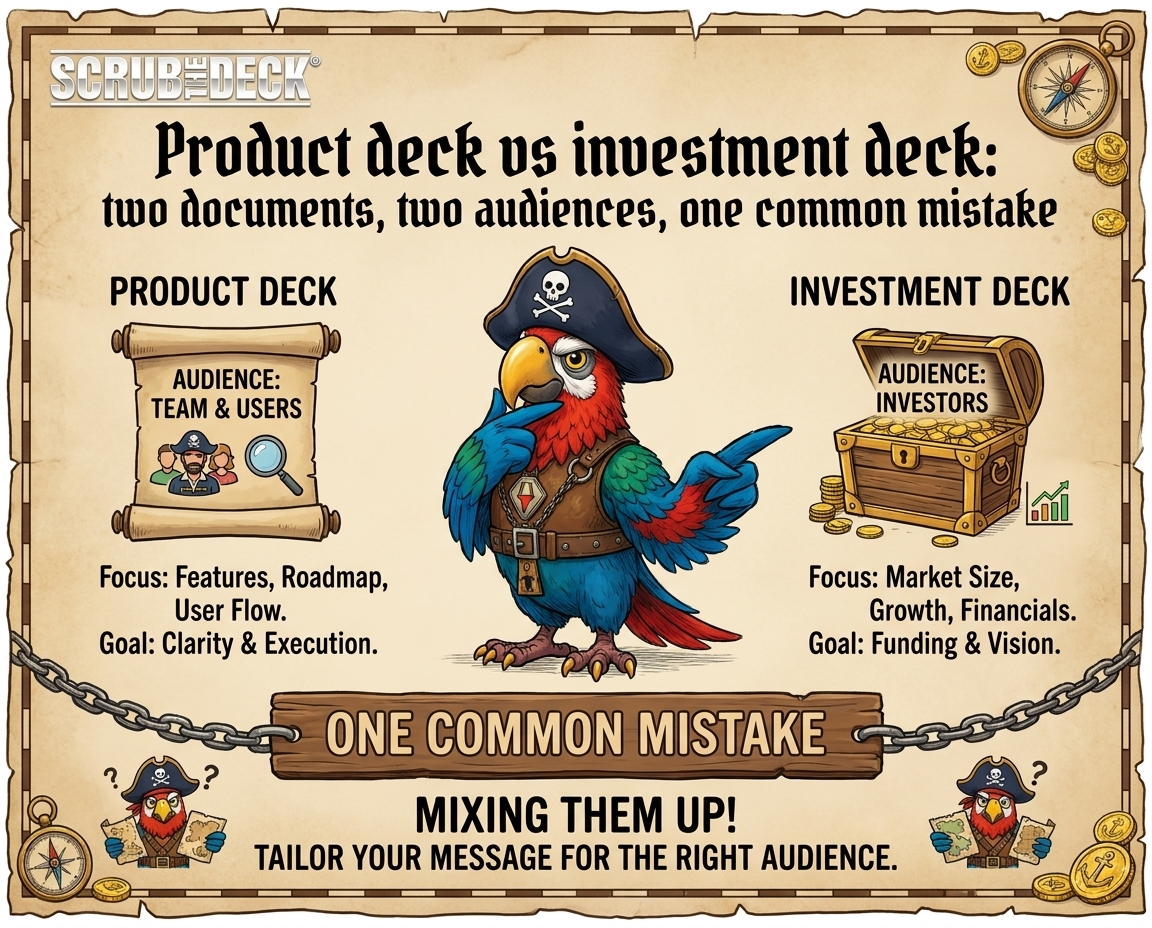
A product deck explains what your product does, who it is for, and how it works. An investment deck explains why your business will generate returns. They are built for different audiences with different objectives. A product deck is for customers and partners who need to understand your offering. An investment deck is for investors who are evaluating whether to allocate capital to your company. Sending a product deck to an investor is one of the most common and most costly mistakes founders make in a fundraising process.
The National Venture Capital Association found that 89% of VCs expect to receive a pitch deck as the first point of contact. What they expect is an investment deck. What most founders send is a product deck, because that is the document they built first, they know it well, and they believe it represents their business most accurately. It represents the product accurately. It does not represent the investment case accurately. Those are two separate things.
Why do founders confuse product decks and investment decks?
Founders confuse product decks and investment decks because they build the product before they build the investment case. By the time they need to raise, they have a detailed product story and no investment story. The product deck gets repurposed. Key details are added: market size, financials, a team slide. But the underlying structure of the document remains product-led, not investor-led. The argument is built around what the product does rather than around why the business generates returns.
The practical consequence is a deck that answers questions investors are not asking while leaving the questions they are asking unanswered. An investor looking at an early-stage deck wants to know: what is the market size and is it defensible, what is the unit economics story, who is doing this and why are they the right team, what has happened so far that proves the thesis, and what does the return look like at exit. A product deck typically answers one of those questions in detail and gestures at the others. That is not enough to generate a meeting.
According to Harvard Business School and DocSend research, founders who close seed rounds contact a median of 58 investors and take 12 or more weeks to close. A document that does not answer the investor's core questions is part of why the process takes that long.
What does an investment deck include that a product deck does not?
An investment deck includes explicit financial logic, market size with a clear route to your serviceable obtainable market, unit economics that demonstrate the business is viable at scale, and a clear exit pathway. A product deck typically omits or simplifies all of these. The investment deck also leads with credibility signals on slide one rather than a product explanation. It frames the team slide as the primary evidence of execution capability rather than a secondary introduction. And it treats the competitor landscape as a market positioning argument rather than a feature comparison table.
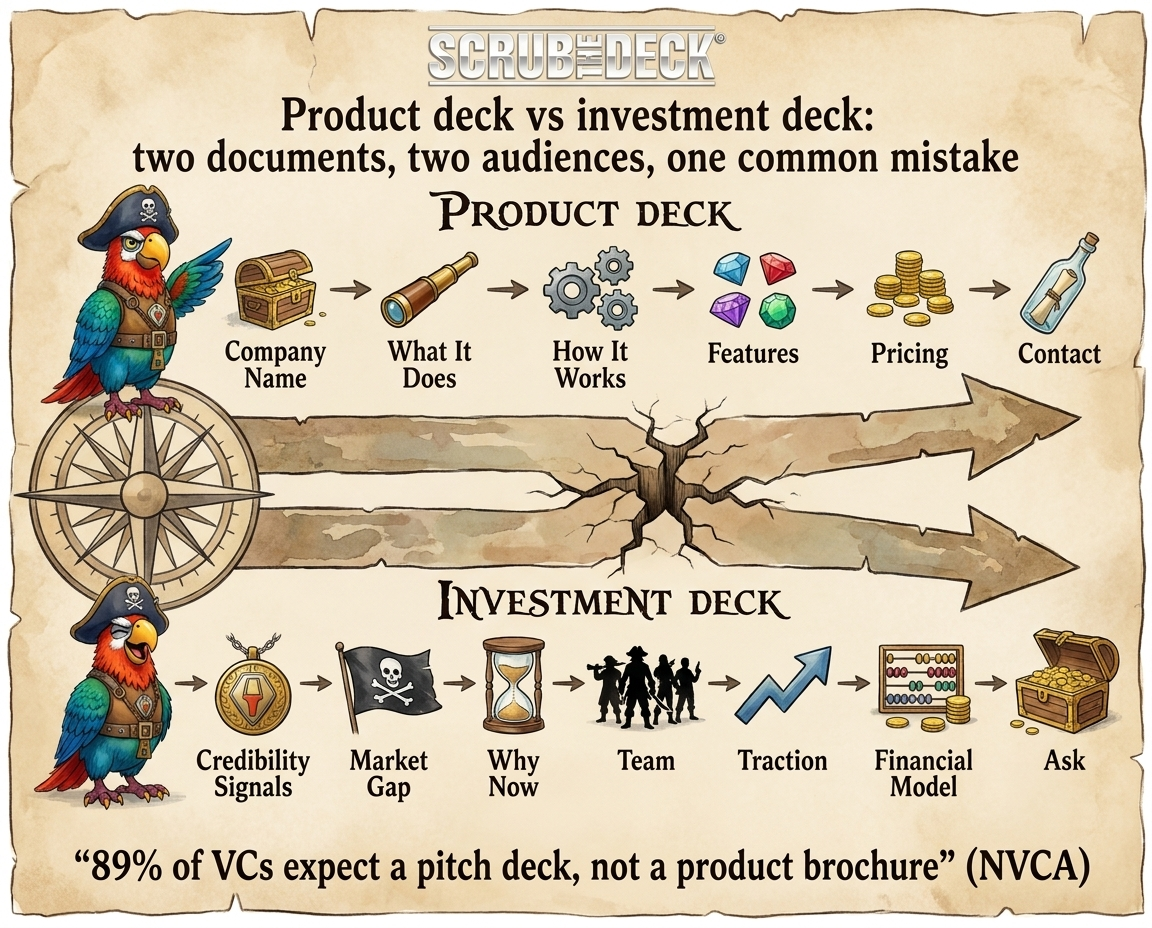
The table below shows the core differences in how each document approaches the same slides:
| Slide | Product deck approach | Investment deck approach |
|---|---|---|
| Cover | Company name, tagline, logo | Credibility signals: investors in, client logos, track record |
| Problem | Customer frustration narrative | Market failure at scale, size of the gap |
| Solution | Feature list, product screenshots | Outcome for the customer, proof it works |
| Market | TAM figure from a report | TAM, SAM, SOM with a route to SOM |
| Business model | Pricing tiers | Revenue per customer, LTV, CAC, margin structure |
| Team | Job titles and employer logos | Specific credentials relevant to execution of this business |
| Financials | Revenue projection chart | Revenue model, key assumptions, path to profitability |
| Ask | How much you need | How much, what for, what it achieves, expected return |
When should you use a product deck versus an investment deck?
Use a product deck when speaking with potential customers, technology partners, or advisors who need to understand what you have built. Use an investment deck when speaking with any capital allocator: VCs, angel investors, family offices, corporate venture arms, and grant panels that evaluate commercial viability. The line is simple. If the person you are sending the deck to is being asked for money, send the investment deck. If they are being asked for a commercial relationship, send the product deck.
There are situations where the two overlap, particularly with strategic investors who are also potential customers. In those cases, the investment deck takes priority. A strategic investor is still an investor. Their commercial relationship with you is secondary to their financial relationship with you. An investment deck does not prevent a commercial conversation. A product deck often prevents an investment conversation.
According to DocSend analysis of 320 pitch decks, investors disproportionately engage with the financials and team sections of a deck. Both of those sections are investment-led content. Sending a product deck to an investor de-emphasises the sections they care most about while over-emphasising the sections they care least about at first contact.
How do you convert a product deck into an investment deck?
Converting a product deck into an investment deck requires rebuilding the argument, not reformatting the slides. The sequence of changes to make, in order of impact, is: restructure the opening slide to front-load credibility rather than explanation, rewrite the market slide to include SAM and SOM with a route to capturing them, add or expand the financials slide to include assumptions and unit economics, rewrite the team slide to focus on specific relevant credentials rather than titles, and rewrite the ask slide to include what the investment achieves and what the expected return scenario looks like.
Beyond those structural changes, the language throughout needs to shift from product language to return language. Product decks use words like "users," "features," "functionality," and "roadmap." Investment decks use words like "customers," "revenue," "margin," and "defensibility." The switch is not cosmetic. It reflects a genuine shift in perspective from "what we built" to "why this business will succeed and return capital."
If you need to maintain both documents, keep them separate and name them differently. Sending the wrong one to the wrong audience is a small mistake with a large consequence: it signals that you do not understand who you are speaking to. No investor wants to back a founder who cannot read their audience.
Does the investment deck change at different funding stages?
Yes, significantly. At pre-seed, the investment deck leans heavily on the team and the market opportunity, because traction data is limited or non-existent. At seed, the deck needs to show early traction, unit economics, and a clear plan for what the seed capital achieves. At Series A and beyond, the deck becomes increasingly data-led: proven revenue model, demonstrable growth, competitive moat, and a clear path to profitability or to the next major milestone that de-risks the business for the next investor in line.
The 18-point Connect and Convince structure used by Scrub the Deck accounts for stage-specific requirements at each level. A pre-seed deck built to the same framework as a Series A deck will not work, and vice versa. Stage is as important as content when building the investment case. An investor evaluating a pre-seed opportunity who receives a Series A-style data-heavy deck will question whether the founder understands how early they are. An investor evaluating a Series A opportunity who receives a vision-heavy pre-seed style deck will question whether the business has actually proven anything.
For a full overview of the structure that works at each stage, see: How to Write a Pitch Deck That Gets Investment.
Related guides in this series
- How to Write a Pitch Deck That Gets Investment -- the complete 18-point structure for investment decks, from cover slide to ask slide
- Why AI-Generated Pitch Decks Are Killing Your Fundraise -- why AI tools produce product decks when investors need investment decks
- How to Write the Team Slide in Your Pitch Deck -- the slide that changes most between product decks and investment decks
Frequently asked questions
- What is a product deck?
- A product deck is a presentation that explains what a product does, who it is for, and how it works. It is designed for customers, partners, or anyone evaluating a commercial relationship with the company. It is built around the product's features and outcomes for the user, not around the financial case for investment.
- What is an investment deck?
- An investment deck is a presentation built for investors. It explains the market opportunity, the financial model, the team's credentials, and why the business will generate returns. It is not primarily about product features. It is about the investment case: why this business, why this team, why now, and what does the investor get back.
- Can you use the same deck for customers and investors?
- No. A product deck and an investment deck serve different audiences with different objectives. Sending a product deck to an investor means they will not see the financials, unit economics, and team credentials they need in order to say yes. Sending an investment deck to a customer means they will see financial projections and exit scenarios that are irrelevant to their decision.
- How do you convert a product deck into an investment deck?
- Restructure the opening slide to front-load credibility signals, rewrite the market slide to include SAM and SOM with a route to capturing them, add unit economics to the financials slide, rewrite the team slide to focus on relevant credentials rather than titles, and rewrite the ask slide to include what the investment achieves and what the expected return looks like.
- Does an investment deck change at different funding stages?
- Yes. At pre-seed, the deck leans on team and market opportunity because traction is limited. At seed, it needs early traction, unit economics, and a clear use of funds. At Series A and beyond, the deck becomes data-led: proven revenue model, growth trajectory, competitive moat, and a defined path to the next major de-risking milestone.
- Why do most pitch decks fail to get investor meetings?
- Most pitch decks fail because they are product decks presented to investors. They explain the business instead of making the investment case. According to Harvard Business School and DocSend research, the average seed founder takes 12 or more weeks to close a round after contacting 58 investors. A deck that answers the wrong questions extends that timeline significantly.
Sources
- 89% of VCs expect to receive a pitch deck during the fundraising process — National Venture Capital Association survey via pitchdeckcreators.com
- Founders contact a median of 58 investors and take 12 or more weeks to close a seed round — Harvard Business School and DocSend research via pitchdeckcreators.com
- Investors disproportionately engage with financials and team sections — DocSend analysis of 320 pitch decks