How to Write the Team Slide in Your Pitch Deck
22 years in design and communication with global brands. Since forming Scrub the Deck: raised millions for startups. 82% investor meeting success rate, the highest in this space. 1,500+ investor network.
By David Pugh, founder of Scrub the Deck. With 22 years working with global brands in design and communication, David formed Scrub the Deck where he has raised millions for startup and scale-up companies across pre-seed to Series B, achieving an 82% investor meeting success rate, the highest in this space.
Last updated: 1 July 2026
Part of the Complete Guide to Writing a Pitch Deck That Gets Investment.
Why is the team slide the most important slide in a pitch deck?
For early-stage companies, the team slide is the investment thesis. When a business has limited revenue, no proven product-market fit, and projections that are necessarily speculative, the investor is not betting on the numbers. They are betting on the people. The team slide is the only place in the deck where the investor can evaluate whether those people are credible, relevant, and capable of building what they are proposing to build. Get this slide wrong and the rest of the deck is irrelevant.
DocSend analysis of 320 pitch decks found that the team slide appears in 100% of successfully funded decks and receives disproportionate reading time from investors. It is not optional and it is not a formality. Harvard Business School research confirms that investors weigh founder credentials heavily in early-stage decisions, particularly when revenue data is thin or absent. The team slide is where that evidence lives.
What do investors actually look for in the team slide?
Investors look for three things in the team slide: relevant track record, complementary skills across the founding team, and signals of execution capability. Relevant track record means prior experience that is directly applicable to the business being built. If you are building a fintech product and your co-founder previously held a senior role at a regulated financial institution, that is relevant and should be prominent. If you are building a marketplace and your co-founder previously built and exited a marketplace, that is even more relevant and should be the first thing they see.
Complementary skills means the founding team covers the core functions required to build and sell the product without immediate external hires. A technical co-founder and a commercial co-founder is the standard pairing for early-stage businesses. Showing that gap clearly, and showing who fills it, is more reassuring to investors than a team of three technical co-founders or three commercial co-founders with identical skill sets.
Execution capability is harder to show in a slide but possible. The strongest signals are: prior company building experience, evidence of taking something from zero to a meaningful milestone, and specific achievements with quantified outcomes rather than vague descriptions of responsibility. "Grew revenue from £0 to £2m in 18 months at [previous company]" is an execution signal. "Led growth at [previous company]" is not.
How should you format the team slide in your pitch deck?
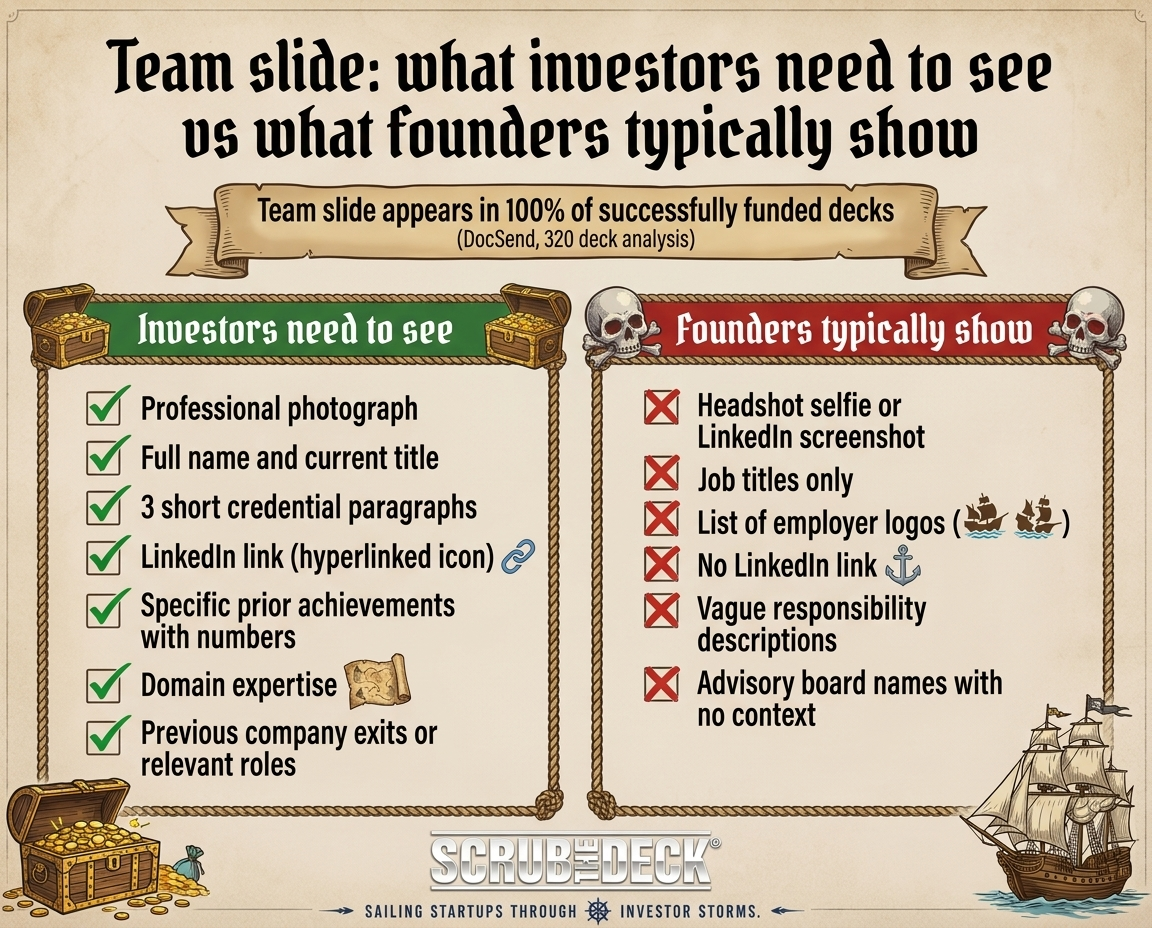
The format that works for the team slide is: professional photograph, full name, current title at the company, three short paragraphs covering prior experience, and a LinkedIn link for due diligence. Three short paragraphs is the right length. One paragraph is too thin to establish credibility. Four or more paragraphs is too long for a slide that needs to communicate clearly at a glance. Each paragraph should cover one distinct aspect of the founder's credentials: prior company experience, sector expertise, and the specific capability they bring to this business.
Professional photography is not optional. The team slide is the only slide in the deck where the investor is assessing the people rather than the business. A blurry LinkedIn screenshot or a casual photo from a company event signals that the founders did not take the slide seriously. That signal is not helpful. Professional photography does not need to be expensive. It needs to be clean, well-lit, and consistent across the team.
The LinkedIn link serves a specific purpose: it allows an investor to verify the credentials on the slide without having to ask. Investors who are interested will check LinkedIn. Make that check easy by including the link, and make sure the LinkedIn profile matches what the slide claims. Inconsistencies between the deck and the LinkedIn profile are a due diligence red flag that surfaces later in the process and damages trust at the worst possible moment.
What mistakes do founders make on the team slide?
The most common team slide mistakes, in order of frequency, are: using job titles instead of accomplishments, listing the team chronologically rather than leading with the most impressive credential, including team members who are advisors or part-time contributors without making that distinction clear, and omitting the LinkedIn link so investors have to search for it manually.
A specific mistake that British founders make disproportionately is underselling. The cultural norm in the UK is to present achievements modestly, to let the work speak for itself, and to avoid language that sounds boastful. That cultural norm is appropriate in most social contexts. It is not appropriate on a team slide. Investors are not British in their reading of team slides. They are looking for founders who can articulate their own strengths clearly and without apology. A team slide written in the British understatement tradition will read as a lack of conviction to a US investor and as a team that does not know how to sell itself to an international investor.
The fix is to write the team slide in the third person and to treat each founder as if you were writing a recommendation for someone else. That shift in voice typically allows founders to write more directly about achievements without it feeling uncomfortable to write or self-aggrandising to read.
How do you write the team slide if you are a solo founder?
Solo founders face a harder team slide problem because investors know that a single person cannot build and sell a product simultaneously at the speed required to compete. The team slide for a solo founder needs to address this directly rather than hoping the investor does not notice the gap. There are three approaches that work: showcasing the advisors who fill the missing functions, highlighting key early hires who are already in place, or making a direct argument for why the specific business being built does not require a co-founder at this stage.
The advisor approach works when the advisors are genuinely engaged, have relevant credentials, and are willing to be contacted by investors for reference. An advisory board of five names that investors cannot verify is worse than no advisory board. A single advisor with a direct relationship with the founder and a specific role in the business is worth far more. If you list advisors on the team slide, include their specific contribution to the business, not just their title at their primary employer.
The early hires approach works when you have made at least one hire who fills a clear skill gap. A technical founder who has hired a Head of Sales, or a commercial founder who has hired a CTO, is demonstrating execution and self-awareness simultaneously. That combination is reassuring to investors who are worried about the single-point-of-failure risk of a solo founder.
Should the team slide come early or late in a pitch deck?
For early-stage companies, the team slide should come earlier in the deck than most templates suggest. The standard Sequoia template places the team slide near the end, after the market, product, traction, and financials. That ordering makes sense when the business has a strong independent case. For pre-seed and seed companies where the team is the primary thesis, placing the team slide after the problem and solution slides, before the market and financial slides, gives investors the context they need to evaluate the rest of the deck with the right frame of reference.
If the investor does not believe in the team, they will read the market size and financial projections with scepticism. If they do believe in the team first, the same slides read as evidence of a credible plan rather than as assertions they have to take on trust. The sequence of the argument in a pitch deck is as important as the content of each individual slide. Build the order around when the investor needs each piece of information to stay engaged and persuaded.
For the full pitch deck structure and where each slide fits within the 18-point Connect and Convince framework, see: How to Write a Pitch Deck That Gets Investment.
What credentials should go on the team slide for a first-time founder?
First-time founders often assume that without a prior exit or a recognisable employer on their CV, the team slide will be weak by definition. That assumption is wrong, but the team slide needs to be built differently. The credentials that matter for a first-time founder are: deep domain expertise in the market you are entering, specific technical skills that are directly required to build the product, evidence of prior execution in any context, and sector relationships that demonstrate insider access to customers or distribution.
Domain expertise is particularly powerful for first-time founders because it is the one form of credibility that cannot be faked and cannot be hired quickly. A founder who spent ten years inside the industry they are disrupting, who knows the buyer psychology, the distribution channels, the regulatory environment, and the key relationships, has a credibility advantage over a more experienced founder who is entering the same market from the outside. Make that expertise explicit and specific on the team slide. Name the companies you worked at, the deals you did, the relationships you built, and the problems you saw from the inside that you are now positioned to solve.
According to DocSend analysis of 320 pitch decks, team credibility is one of the most heavily weighted factors in early-stage investor decisions. A first-time founder with a specific and credible domain expertise story will generate more investor interest than a repeat founder whose background is not relevant to the business they are building now.
Related guides in this series
- How to Write a Pitch Deck That Gets Investment -- the full 18-point structure including where and how to position the team slide
- Why AI-Generated Pitch Decks Are Killing Your Fundraise -- why the team slide is the section AI tools handle least effectively
- Product Deck vs Investment Deck: The Mistake That Costs Founders Meetings -- how the team slide changes between the two document types
Frequently asked questions
- Why is the team slide so important in a pitch deck?
- For early-stage companies, the team slide is the investment thesis. When revenue is limited and the product is unproven, investors are betting on the founders. The team slide is the only place in the deck where that evidence lives. DocSend analysis of 320 pitch decks found the team slide receives disproportionate investor time and appears in 100% of successfully funded decks.
- What should a team slide include?
- A team slide should include a professional photograph, full name, current title, three short paragraphs covering prior experience and sector credentials, and a LinkedIn link for investor due diligence. Each founder's section should lead with their most relevant achievement, not their most recent job title. Specific accomplishments with numbers outperform vague descriptions of responsibility.
- Where should the team slide go in a pitch deck?
- For early-stage companies, position the team slide early -- after the problem and solution slides, before the market size and financials. When the team is the primary thesis, investors need to believe in the founders before they will read the market data and projections with confidence. Standard templates that place the team slide late are designed for businesses with strong independent financial evidence.
- How do you write a team slide if you are a solo founder?
- Solo founders should address the gap directly rather than hoping investors do not notice. The three approaches that work are: showcasing genuinely engaged advisors who fill missing functions, highlighting key early hires already in place, or making a specific argument for why the business does not require a co-founder at this stage. Listing advisors who cannot be verified is worse than no advisory board.
- How do you write a team slide as a first-time founder?
- Focus on domain expertise rather than prior exits. A founder with ten years inside the industry they are entering has a credibility advantage over an experienced founder who is new to the sector. Name the companies you worked at, the deals you were involved in, the specific relationships you have built, and the problems you saw from the inside that you are now positioned to solve.
- Should advisors be included on the team slide?
- Include advisors only if they are genuinely engaged, have directly relevant credentials, and are willing to be contacted by investors. An advisory board of five names investors cannot verify is worse than no advisory board. A single advisor with a specific and active role in the business adds more credibility than a list of impressive names who are not meaningfully involved.
- What photographs should founders use on the team slide?
- Professional photographs are required. Clean, well-lit, and consistent in style across the founding team. A blurry LinkedIn screenshot or casual photo signals that the founders did not take the slide seriously. Investors assess the people on the team slide as much as the business. A professional photograph is the minimum visual standard for a slide that deserves serious consideration.
Sources
- The team slide appears in 100% of successfully funded decks reviewed — DocSend analysis of 320 pitch decks via pitchdeckcreators.com
- Harvard Business School research confirms investors weigh founder credentials heavily in early-stage decisions — Harvard Business School research via pitchdeckcreators.com
- Team credibility is one of the most heavily weighted factors in early-stage investor decisions — DocSend analysis of 320 pitch decks via pitchdeckcreators.com