Why AI-Generated Pitch Decks Are Killing Your Fundraise
22 years in design and communication with global brands. Since forming Scrub the Deck: raised millions for startups. 82% investor meeting success rate, the highest in this space. 1,500+ investor network.

By David Pugh, founder of Scrub the Deck. With 22 years working with global brands in design and communication, David formed Scrub the Deck where he has raised millions for startup and scale-up companies, building a personal investor network of 1,500+ contacts and achieving an 82% investor meeting success rate, the highest in this space.
Last updated: 1 July 2026
Part of the Complete Guide to Writing a Pitch Deck That Gets Investment.
Do investors reject AI-generated pitch decks?
Yes, and they are doing it faster than most founders realise. AI pitch deck tools have improved significantly, but investors who review hundreds of decks per year recognise the patterns within seconds: generic language, interchangeable market framings, financial projections that follow a standard growth curve, and problem statements that could describe any business in the category. The speed of recognition is the problem. A deck that triggers pattern-match rejection does not get read. It gets archived.
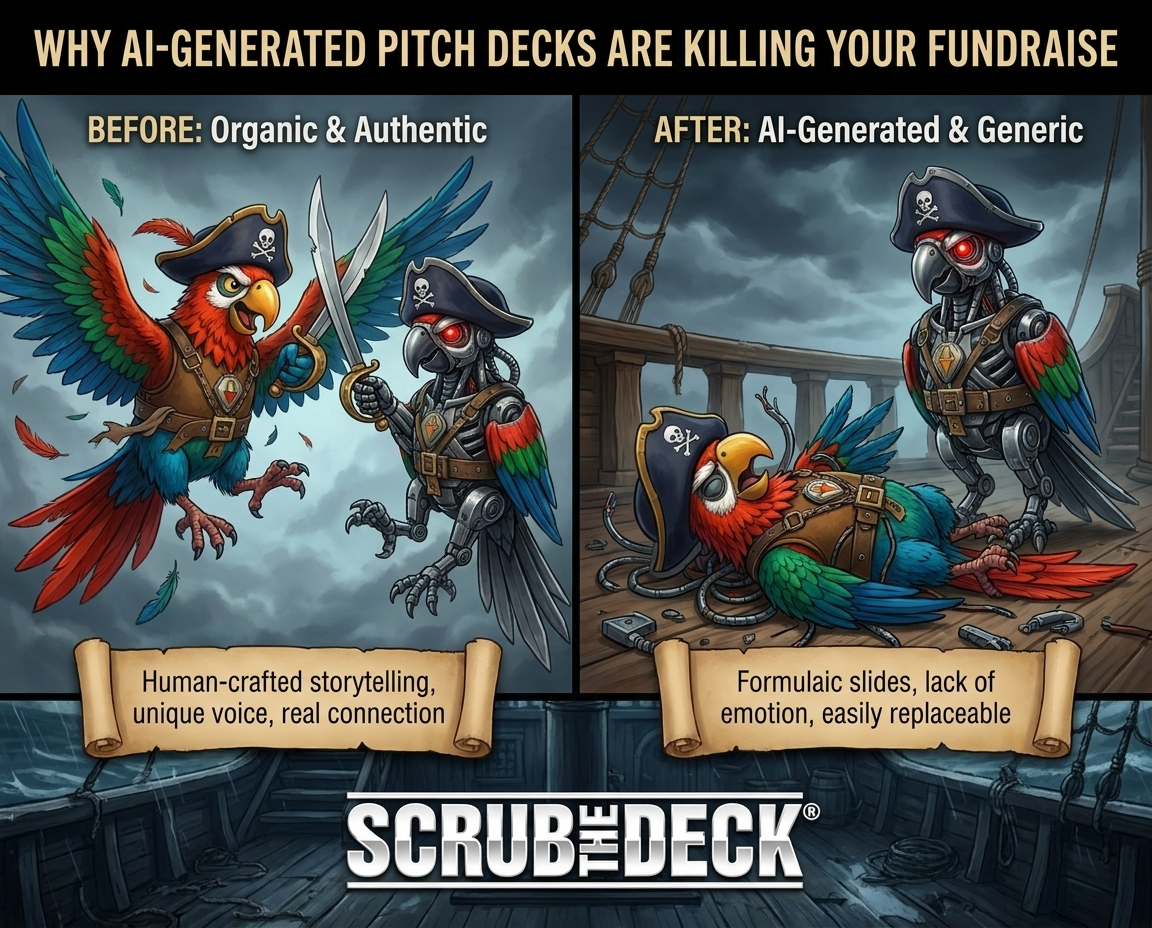
PitchBook data from 2025 shows that AI companies captured 65% of all venture value that year, up from 46% the year before. Every founder with an AI-adjacent business is now competing in the most crowded pitch environment in venture history. In that context, a deck that reads like it was generated by the same tool every other founder is using is not just forgettable. It is actively harmful to your raise. Investors use AI tools too, and they can identify AI-generated text in the same way a recruiter identifies a template CV.
How do investors spot an AI-generated pitch deck?
Investors identify AI-generated pitch decks through a combination of language patterns, structural sameness, and the absence of specific detail. The clearest tells are: problem statements that describe the market category rather than the actual problem a specific customer has, solution slides that use the phrase "our platform" or "our solution" without ever stating what the product actually does, and financial projections that show a standard J-curve from year one without any identifiable mechanism for the growth claimed.
Additional signals include: team slides with no real credentials beyond job titles, market size slides that cite TAM, SAM, and SOM from a publicly available report without any original analysis, and competitor matrices that show the company excelling on every axis. These are not just AI tells. They are the tells of a founder who has not thought hard enough about the argument the deck needs to make. AI tools generate the structure. They do not generate the insight, the proof, or the specificity that makes a deck worth reading.
According to Harvard Business School research, investors spend an average of 3 minutes and 44 seconds reviewing a pitch deck. A deck that triggers a generic recognition within that window will not recover. First impressions in pitch decks are permanent.
Why does an AI pitch deck hurt your chances even if the content is accurate?
An AI-generated pitch deck signals three things that investors find damaging, regardless of the accuracy of the content inside it. First, it signals that the founder has not invested serious time in their fundraising process. Pitch prep is a proxy for how the founder approaches every challenge. If the deck is a 20-minute AI output, what does that suggest about how they will handle investor relations, product decisions, or hiring? Second, it signals that the deck has not been tailored to the investor's specific thesis. Generic decks are generic because they are not aimed at anyone in particular. Investors want to feel that the founder understands what they look for. Third, a generic deck among a sea of generic decks has no competitive advantage. Investors compare decks, whether consciously or not, and a deck that reads like every other deck in the same vertical has no reason to be prioritised.
DocSend analysis of 320 pitch decks found that investors disproportionately engage with decks that demonstrate specificity in the traction and team sections. Those two sections are the ones AI tools handle worst. Traction requires real data. Team slides require real people with real credentials. AI cannot generate either. The sections that matter most are the sections AI tools leave weakest.
Can you use AI tools in your pitch deck process without hurting your chances?
Yes, but the distinction is important. AI tools are useful for the structural and organisational tasks in deck preparation: drafting a first outline, checking the logical flow of slides, generating alternative phrasings for a specific sentence, and identifying gaps in the narrative. These are tasks where AI accelerates the human's work without replacing the human's thinking. The problem arises when founders use AI to generate the argument itself, rather than to refine and communicate an argument they have already built through research and reflection.
The test is simple: can you explain every claim in your deck, in your own words, without the deck in front of you? If the answer is no for any section, that section was generated rather than built. Investors test this in the meeting. A founder who cannot explain the assumptions behind their financial projections, or the research behind their market size figure, loses credibility faster than if they had never been invited to the meeting at all.
Use AI to sharpen language after the thinking is done. Do not use AI as a substitute for the thinking itself.
What should an AI-free pitch deck include instead?
A pitch deck that stands out in the current environment does three things that AI tools cannot do. It tells a specific story: not "founders in this space are frustrated by X" but "we spoke to 47 potential customers and 39 of them told us the same thing, which was Y." It shows real proof: not a projected J-curve but the actual numbers that have happened so far, however early. And it presents real people: not "our team has 30 years of combined experience" but three short paragraphs for each founder, with a professional photograph, a LinkedIn link, and one specific credential that makes this team the right one to build this business.
The competitive position slide is where the gap between AI decks and good decks is most visible. AI tools generate the standard 2x2 matrix with the company in the top right corner. Investors have seen thousands of those matrices. A real competitive analysis identifies three to five specific competitors by name, explains exactly what each one does well, and then makes a precise argument for why the company being pitched fills a gap those competitors cannot fill. That argument cannot be generated by a tool. It requires the founder to have done the competitive research themselves.
For the full framework on how to build a pitch deck that does not rely on AI templates, see: How to Write a Pitch Deck That Gets Investment.
How do you make your pitch deck feel personal and specific to each investor?
The minimum viable personalisation for each investor is one paragraph on the cover email and one modification to the deck itself. The cover email should reference something specific about the investor's portfolio or stated thesis. The deck modification should reflect what that investor values most. A VC who talks publicly about network effects should see your network effects slide positioned and articulated differently than a family office that focuses on revenue quality and margin structure. This does not mean building a new deck for every investor. It means knowing which slides to adjust, and why, before each send.
Beyond that, the language throughout the deck should be the founder's language, not a tool's language. Investors meet founders before they invest. The deck is a preview of that meeting. If the language in the deck does not match how the founder speaks and thinks, the meeting will feel dissonant at best and dishonest at worst. Write the deck in the same voice you would use to explain the business over coffee. Then edit for clarity. That sequence, talking first and editing second, produces decks that read as authentic and specific rather than generated and generic.
According to DocSend research, founders who close seed rounds contact a median of 58 investors. Each of those contacts deserves a version of the deck that was written with them in mind.
Related guides in this series
- How to Write a Pitch Deck That Gets Investment -- the full structure, from slide one to the ask slide, and the 18-point framework investors respond to
- Product Deck vs Investment Deck: The Mistake That Costs Founders Meetings -- why sending the wrong document type to investors costs more meetings than a weak deck
- How to Write the Team Slide in Your Pitch Deck -- the slide AI tools handle worst and investors weigh most heavily
Frequently asked questions
- Can investors tell if a pitch deck was made with AI?
- Yes, and experienced investors identify AI-generated pitch decks quickly. The tells include generic problem statements, interchangeable market framings, competitor matrices where the company excels on every axis, and team slides with no real credentials. These patterns appear across thousands of decks and investors recognise them on sight.
- Is it wrong to use AI tools when writing a pitch deck?
- No. Using AI tools to refine language, improve structure, or check logical flow is sensible. The problem arises when founders use AI to generate the underlying argument rather than to sharpen one they have already built through research. The argument, the data, and the team credentials must come from the founder, not a tool.
- What makes a pitch deck look AI-generated?
- The clearest tells are: problem statements that describe a category rather than a specific customer situation, solution slides using 'our platform' without saying what the platform does, financial projections following a generic J-curve with no stated assumptions, and team slides showing titles instead of accomplishments. These patterns individually are weak; together they signal a generated rather than built deck.
- How do you personalise a pitch deck for each investor?
- The minimum viable personalisation is a cover email that references something specific about the investor's portfolio or stated thesis, and one modification to the deck that reflects what that investor values. Beyond that, use language that matches how you actually speak about the business. If the deck does not sound like the founder in a meeting, it will feel disconnected when the meeting happens.
- Do AI pitch deck tools save time?
- They save time at the wrong stage of the process. The time investment in a pitch deck should be in building the argument: the research, the competitive analysis, the financial model. Those tasks require human thinking. AI tools speed up the writing of a first draft once the thinking is done, which is a small fraction of the total time a good pitch deck takes to build properly.
Sources
- AI companies captured 65% of all venture value in 2025, up from 46% the year before — PitchBook 2025 venture data via altersquare.io
- Investors spend an average of 3 minutes 44 seconds reviewing a pitch deck — Harvard Business School study via pitchdeckcreators.com
- Investors disproportionately engage with decks that demonstrate specificity in the traction and team sections — DocSend analysis of 320 pitch decks
- Founders who close seed rounds contact a median of 58 investors — DocSend research via pitchdeckcreators.com