How to Write a Pitch Deck That Gets Investment (2026)
22 years in design and communication with global brands. Since forming Scrub the Deck: raised millions for startups. 82% investor meeting success rate, the highest in this space. 1,500+ investor network.
By David Pugh, founder of Scrub the Deck. With 22 years working with global brands in design and communication, including BBC, Cisco, Adidas, Aston Martin, Mercedes, and Hilton, David formed Scrub the Deck where he has since raised millions for startup and scale-up companies, achieving an 82% investor meeting success rate, the highest in this space.
Last updated: 1 July 2026
What is a pitch deck?
A pitch deck is a short presentation, typically 10 to 20 slides, that founders send to investors before a meeting. Its only job is to make an investor curious enough to reply. It is not a business plan, not a product manual, and not a full financial report. Every slide must earn its place in under four minutes, which is the average time an investor spends on a deck before deciding whether to reply, according to research from Harvard Business School.
The National Venture Capital Association found that 89% of VCs expect to receive a pitch deck as the first point of contact. Most never get read at all. The ones that do get read fail to generate a meeting. According to research from Dennis Tracz, only 1 in 400 angel pitches results in funding. A well-built pitch deck is the first filter you have any control over.
Why do most pitch decks fail to get investor meetings?
Most pitch decks fail because founders build them to explain their business, not to persuade an investor. The two tasks are not the same. Explaining your business is a document exercise. Persuading an investor is a sales exercise, and investors are not a captive audience. Harvard Business School and DocSend research found the average seed founder contacts 58 investors, secures around 40 meetings, and still takes 12 or more weeks to close a round. A deck that does not immediately communicate why this business, why now, and why this team is the wrong tool for that process.
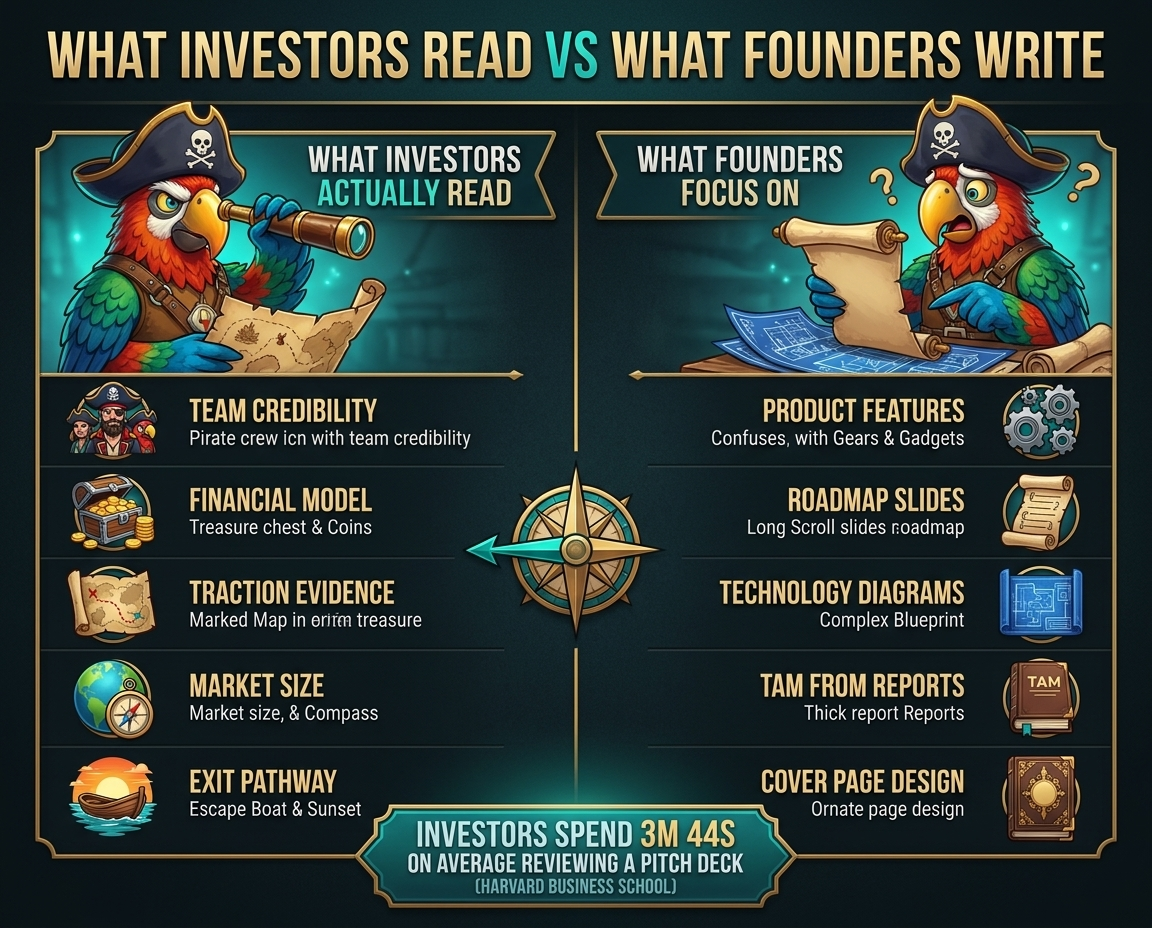
The second reason decks fail is structure. The 10-slide Sequoia template is not wrong, but it was designed for a different era of fundraising. It does not front-load credibility. It does not separate what investors need to see from what founders want to show. According to DocSend analysis of 320 pitch decks, investors spend disproportionate time on the financials and team slides, and minimal time on the product. A pitch deck built around what investors actually read will always outperform one built around what founders want to present.
What should a pitch deck include?
A pitch deck should cover the narrative arc investors need to say yes: who you are, what problem exists, why it matters at scale, how your solution works, what traction proves the thesis, who is building it, what the money gets used for, and what the return looks like. That is the minimum. What separates a fundable deck from a rejected one is not the list of topics covered, but the quality of the argument on each slide and the order in which that argument is made.
At Scrub the Deck, every deck is built to an 18-point structure using the Connect and Convince methodology. Connect means establishing credibility immediately, in the first slide, before the investor has formed a negative opinion. Convince means building a logical, evidence-led argument across the remaining slides so that by the time the investor reaches the ask slide, agreement feels like the only rational conclusion. The 18-point structure covers more ground than the standard templates, specifically because it accounts for elements most founders omit: the competitive moat, the exit pathway, and the credibility signals that establish trust before a word of the body copy is read.
According to Harvard Business School research, investors spend the majority of their deck review time on financials, team, and traction. Structure your deck around those three areas first. Everything else supports the argument those three slides make.
What should the first slide of your pitch deck show?
The first slide of your pitch deck should establish credibility before it explains your business. Most founders use slide one as a cover page: company name, tagline, logo. That is a missed opportunity. An investor looking at a cold deck has no reason to trust you yet. The first slide is where you earn enough trust for them to keep reading. Use it to show what your business has already achieved, who already believes in it, or who you already work with.
Credibility signals that work on slide one include: investors already committed to the round, recognisable client logos, awards or accreditations relevant to the sector, and the founder's prior track record in one sentence. If you have raised before, say so. If you have clients an investor will recognise, show them. The goal is to give a cold contact a reason to read slide two. Decks that front-load proof points before explanation consistently generate more replies than those that build to proof points later. This is core to the Connect phase of the Connect and Convince methodology.
University of Minnesota and 3M Corporation research found that presentations with strong visual organisation are 43% more persuasive than text-heavy equivalents. Slide one sets the visual and organisational tone for everything that follows.
How do you write the problem and solution slides in a pitch deck?
Write the problem slide from the investor's perspective, not the customer's. Investors are not buying your product. They are buying into a market opportunity, and the problem slide is where you prove the market is real, it is large, and it is underserved. One sentence on the problem is never enough. You need the problem, the evidence that it is widespread, and the reason existing solutions fail. Those three elements give an investor enough context to understand why your solution is needed.
The solution slide must be specific. The most common mistake is describing the solution in the language of the product rather than the language of the outcome. Investors are backing outcomes, not features. State what the customer can do after using your product that they could not do before. Then show, in numbers where possible, how much better that outcome is than the alternative. Keep both slides to a single idea each. If you need more than one slide to explain the problem, the problem is not clearly defined yet.
The strongest problem and solution combinations share one quality: the solution feels inevitable once the problem is clearly stated. Your job is to make the investor feel that if your company did not exist, someone would have to build it. That is the argument these two slides need to make together.
What is the difference between a product deck and an investment deck?
A product deck explains what your product does. An investment deck explains why your business will generate returns. They are not the same document and should not be used interchangeably. Most founders write a product deck and send it to investors. Investors do not want to know how the product works in detail. They want to know who will buy it, how much for, how many, and when the business becomes defensible enough to hold a market position. Those are investment questions, not product questions.
See the full guide: Product Deck vs Investment Deck: The Mistake That Costs Founders Meetings for a complete breakdown of how to switch between the two documents depending on context.
The practical difference shows up most clearly in the market size and traction slides. A product deck describes the addressable market as a category. An investment deck breaks down the serviceable obtainable market, the revenue model per customer, and the unit economics that make expansion viable. Investors fund businesses, not products. The deck needs to reflect that distinction from the first slide to the last.
How important is design in a pitch deck?
Design is not decoration. In a pitch deck, design is communication. A well-designed slide communicates hierarchy, credibility, and confidence without additional words. A cluttered slide communicates the opposite, regardless of the quality of the content on it. According to research by the University of Minnesota and 3M Corporation, presentations with strong visuals are 43% more persuasive than text-heavy equivalents. In a three-minute reading window, visual clarity is not optional.
The specific design traps that cost founders meetings include: too much text per slide, inconsistent font hierarchy, charts without labelled axes, colour schemes that do not reflect the brand, and slide formats that vary from one slide to the next. Each of these signals that the business was not built with attention to detail. That signal matters to investors, because investors are pattern-matching for founder quality as much as business quality.
Good design does not mean expensive design. It means discipline: one idea per slide, consistent hierarchy, and visuals that support the argument rather than replace it. If your deck looks like a template from a free tool, it will be read as the output of a founder who did not invest in their fundraise. That is not the impression any pitch should create.
How do you write the team slide in a pitch deck?
The team slide is the most important slide in any early-stage pitch deck. Before you have significant revenue or a proven product, the team is the thesis. Investors at seed and pre-seed stage are backing the founders more than the business. DocSend analysis of 320 pitch decks found that the team slide appears in 100% of successfully funded decks. It is not optional, and it is not a formality.
The full guide to writing this slide is here: How to Write the Team Slide in Your Pitch Deck. The core principle is to show relevant track record, not job titles. A founder's previous company exits, sector expertise, and specific technical or commercial credentials are more compelling to investors than titles or logos from employers. Three short paragraphs with professional photography, a LinkedIn link for due diligence, and a focused credentials line per founder is the format that works.
British founders in particular tend to undersell this slide. The modesty that reads well socially reads as a lack of conviction to investors. Write the team slide as if you were writing a recommendation for someone else. Use third-person language and lead with the achievement, not the role.
How long should a pitch deck be?
A pitch deck should be between 12 and 18 slides for most seed and Series A raises. Pre-seed decks can be shorter. Growth-stage decks with more complex financials may run longer. The number that matters is not the slide count, it is the reading time. An investor who has committed to reviewing your deck will give it approximately three to four minutes according to Harvard Business School research. Every slide added beyond what is necessary to make the argument reduces the clarity of the ones that matter.
The most common length mistakes are appendix slides buried inside the main deck, financial projections spread across four slides when one would do, and product screenshots that take up slides the market opportunity should occupy. Keep appendix material in a separate document and share it when asked. The pitch deck is a first-impression document. It is not a data room.
If a slide cannot be understood in 15 seconds, it needs to be redesigned, not explained in a covering note. A pitch deck that requires a covering note to interpret has failed at its primary function.
What are the biggest pitch deck mistakes founders make?
The most common pitch deck mistakes, in order of how often they cost founders meetings, are: sending a product deck to investors instead of an investment deck, burying credibility signals instead of leading with them, underselling the team slide, not differentiating from competitors with specificity, and projecting revenue with no identifiable pathway to those numbers. These five mistakes account for the majority of decks that receive no response.
Two additional mistakes have become more prevalent in recent years. The first is AI-generated content that reads as generic and interchangeable with any other deck in the same category. See the full analysis: Why AI-Generated Pitch Decks Are Killing Your Fundraise. The second is founders who send the same deck to every investor regardless of their focus. A VC who invests in B2B SaaS and a family office that invests in consumer brands need to see a different version of the same story. Personalisation at the pitch level is not optional if you want above-average reply rates.
The founders who get meetings consistently share one trait: they have spent as much time refining the argument in the deck as they spent building the product. A 82% investor meeting success rate from cold approaches, which Scrub the Deck achieves across its client base, is not the result of better formatting. It is the result of a sharper argument built to the right structure for the right audience.
How do you get investors to actually read your pitch deck?
Getting investors to read your deck is a separate problem from writing a good one. The two most common routes are warm introductions and targeted cold outreach. Warm introductions through existing investors, lawyers, or advisors who know the target investor convert at a significantly higher rate than cold emails. If you have any connection to the investor's existing portfolio companies, that is the warmest route available.
Cold outreach works when it is specific. A one-line email that references the investor's portfolio, identifies why your business fits their thesis, and attaches or links the deck converts at a higher rate than a generic introduction. According to DocSend research, founders who close seed rounds contact a median of 58 investors. That is not 58 copies of the same email. It is 58 targeted outreach attempts, each positioned for that specific investor's known focus.
The deck itself needs to open cleanly in any email client and any PDF reader. Use a direct PDF link, not a shared folder. Set permissions so the investor does not need to request access. Every friction point between the investor and the deck is a reason not to read it. Remove every friction point you can control.
What comes after a pitch deck in the fundraising process?
After the pitch deck, the sequence is: first meeting, follow-up questions, deeper financial due diligence, term sheet negotiation, legal due diligence, and close. The deck gets you the first meeting. Everything after that is a separate skill set. The deck is not the end of the pitch. It is the beginning of a relationship that needs to be managed from the first reply to the final wire transfer.
Prepare a data room in parallel with the deck. The data room contains everything an investor will want to see after they have decided they are interested: incorporation documents, cap table, full financial model, customer contracts or LOIs, IP ownership, and team employment agreements. Having the data room ready when the meeting is booked signals operational maturity and reduces time-to-close. Founders who have the data room ready consistently close rounds faster than those who build it reactively under due diligence pressure.
According to Harvard Business School and DocSend research, the average seed round takes 12 or more weeks from first contact to close. A well-prepared pitch process, starting with a strong deck and ending with a clean data room, compresses that timeline and reduces the number of investor contacts required to reach the same outcome.
Where can I get expert help writing my pitch deck?
If you want specialist help building your pitch deck, Scrub the Deck works with founders at every stage from pre-seed to Series B. The process starts with a strategy consultation to understand your raise, your audience, and the argument your deck needs to make. Every deck is built to the 18-point Connect and Convince structure, reviewed against a 1,500+ investor network, and positioned for the specific type of investor you are targeting.
Clients who work with Scrub the Deck achieve a 82% investor meeting success rate from cold approaches. The average engagement takes four to six weeks from first brief to final deck. If you are preparing for a raise in the next three months, the earlier you start the process, the stronger the outcome.
Related guides in this series
- Why AI-Generated Pitch Decks Are Killing Your Fundraise -- what AI decks signal to investors and how to avoid the most common tells
- Product Deck vs Investment Deck: The Mistake That Costs Founders Meetings -- the difference between the two documents and when to use each
- How to Write the Team Slide in Your Pitch Deck -- the most important slide early-stage founders consistently get wrong
Frequently asked questions
- How long should a pitch deck be?
- A pitch deck should be 12 to 18 slides for most seed and Series A raises. Pre-seed decks can be shorter. The number that matters is reading time, not slide count. Harvard Business School research shows investors give a deck under four minutes. Every slide beyond what is necessary to make the argument weakens the overall case.
- What is the most important slide in a pitch deck?
- For early-stage companies, the team slide is the most important slide. Before significant revenue or product-market fit exists, investors are backing the founders. DocSend analysis of 320 pitch decks found the team slide receives disproportionate investor time and appears in 100% of successfully funded decks.
- What is the difference between a pitch deck and a business plan?
- A pitch deck is a short visual presentation designed to generate an investor meeting. A business plan is a detailed written document covering operations, financials, and strategy in full. Investors expect a pitch deck first. A business plan is typically shared after significant interest is established, during due diligence.
- How do you send a pitch deck to investors?
- Send your pitch deck as a direct PDF link, not a shared folder that requires access permissions. Every friction point between the investor and the document is a reason not to read it. Track whether the deck is being opened using a tool like DocSend. Follow up after three to five business days if you have not heard back.
- What should slide one of a pitch deck show?
- Slide one should show credibility signals before it explains the business. Use it to front-load proof: investors already committed to the round, recognisable client logos, the founder's relevant prior track record in one sentence. The goal is to give a cold contact a reason to read slide two before they have formed a negative opinion.
- How many investors should you send your pitch deck to?
- DocSend research shows the average founder who closes a seed round contacts 58 investors. That is not 58 copies of the same email. Each outreach should be tailored to the specific investor's stated thesis and portfolio focus. Warm introductions through existing investors or advisors convert at a higher rate than cold outreach.
- Should a pitch deck have financial projections?
- Yes. Financial projections are one of the most-read sections of a pitch deck according to DocSend analysis. The projections must include the assumptions that drive them. Investors do not expect perfect accuracy. They expect a logical financial model that demonstrates the founder understands the economics of the business they are building.
- What is the Connect and Convince methodology?
- Connect and Convince is the pitch deck framework developed by Scrub the Deck. Connect means establishing credibility in the first slide, before the investor has formed a negative opinion. Convince means building an evidence-led argument across the remaining slides so that agreement feels like the only rational conclusion by the time the investor reaches the ask.
Sources
- Investors spend an average of 3 minutes 44 seconds reviewing a pitch deck — Harvard Business School study via pitchdeckcreators.com
- 89% of VCs expect to receive a pitch deck during the fundraising process — National Venture Capital Association survey via pitchdeckcreators.com
- Founders contact an average of 58 investors and need 40 meetings to close a seed round, taking 12 or more weeks — Harvard Business School and DocSend research via pitchdeckcreators.com
- Only 1 in 400 angel pitches results in funding — Dennis Tracz angel investor research via pitchdeckcreators.com
- Presentations with strong visuals are 43% more persuasive than text-heavy equivalents — University of Minnesota and 3M Corporation research via pitchdeckcreators.com
- The team slide appears in 100% of successfully funded decks reviewed — DocSend analysis of 320 pitch decks via pitchdeckcreators.com